Best Mineral for Sheep: How to Support Reproduction, Health, and Flock Performance Year-Round
Updated: October 14, 2026
When it comes to raising a healthy, productive lamb crop, nutrition during pregnancy matters. A ewe’s nutritional status impacts more than just her own body condition. The nutrients she receives throughout gestation also help support the growth and development of the lambs she is carrying.
Minerals are an important part of that nutritional program. While they may be required in much smaller amounts than energy or protein, minerals support many of the processes that help a fetus grow, including bone development, muscle development, immune function and overall growth.
That becomes especially important during the third trimester, when fetal growth accelerates and the nutritional demands on the ewe increase.
How Mineral Nutrition Supports Fetal Development in Sheep
Mineral nutrition supports fetal development in sheep by providing nutrients needed for skeletal growth, tissue development, immune function and other critical biological processes. Providing a balanced mineral program throughout gestation helps the ewe meet her own nutritional needs while supporting the developing lamb or lambs.
Good nutrition does not start when the lamb is born. It starts before birth, with the ewe.
What Is Fetal Programming in Sheep?
Fetal programming is the process by which conditions during pregnancy can influence how an offspring develops and performs later in life. Nutrition is one of the factors that can influence fetal development, making the ewe’s diet an important consideration long before lambing.
The nutrients available to the developing fetus can impact growth and development of tissues and organs. Adequate nutrition helps provide the building blocks needed for normal development, while nutritional deficiencies can limit that development.
For sheep producers, that means the nutrition program used during gestation is about more than simply maintaining the ewe. It is also part of preparing the next generation.
A well-managed nutritional program can help support healthy fetal development and give lambs a better start at birth.
Why the Third Trimester Is Critical for Fetal Development
The third trimester is a particularly important period for fetal development because fetal growth increases rapidly during late gestation. At the same time, the ewe's nutritional requirements are increasing as she supports the developing lamb or lambs.
This is also when the number of lambs a ewe is carrying becomes especially important. A ewe carrying twins or triplets has greater nutritional demands than a ewe carrying a single lamb.
Minerals remain an important part of that late-gestation nutrition. Calcium and phosphorus, for example, are involved in skeletal development, while other minerals support immune function, muscle development and numerous metabolic processes.
Meeting the ewe’s nutritional needs during late gestation is not about feeding more of everything. It is about providing the right nutrients in the right amounts based on the ewe’s stage of pregnancy, body condition, forage quality and number of lambs.
Key Minerals That Support Fetal Development
Several minerals play important roles in fetal development and overall ewe nutrition. Calcium and phosphorus are especially important for developing bones and teeth, while other minerals support muscle development, immune function, oxygen transport and normal metabolic processes.
Trace minerals, including zinc, selenium, manganese and copper, also have important biological functions. However, more is not always better when it comes to trace minerals, particularly in sheep.
Copper deserves special attention because sheep have a relatively narrow margin between adequate copper intake and potentially toxic levels. Copper requirements can also be affected by other minerals and nutrients in the diet.
The goal should always be a balanced mineral program formulated specifically for sheep rather than adding individual minerals without considering the complete diet.
Sheep Nutrition Throughout Gestation
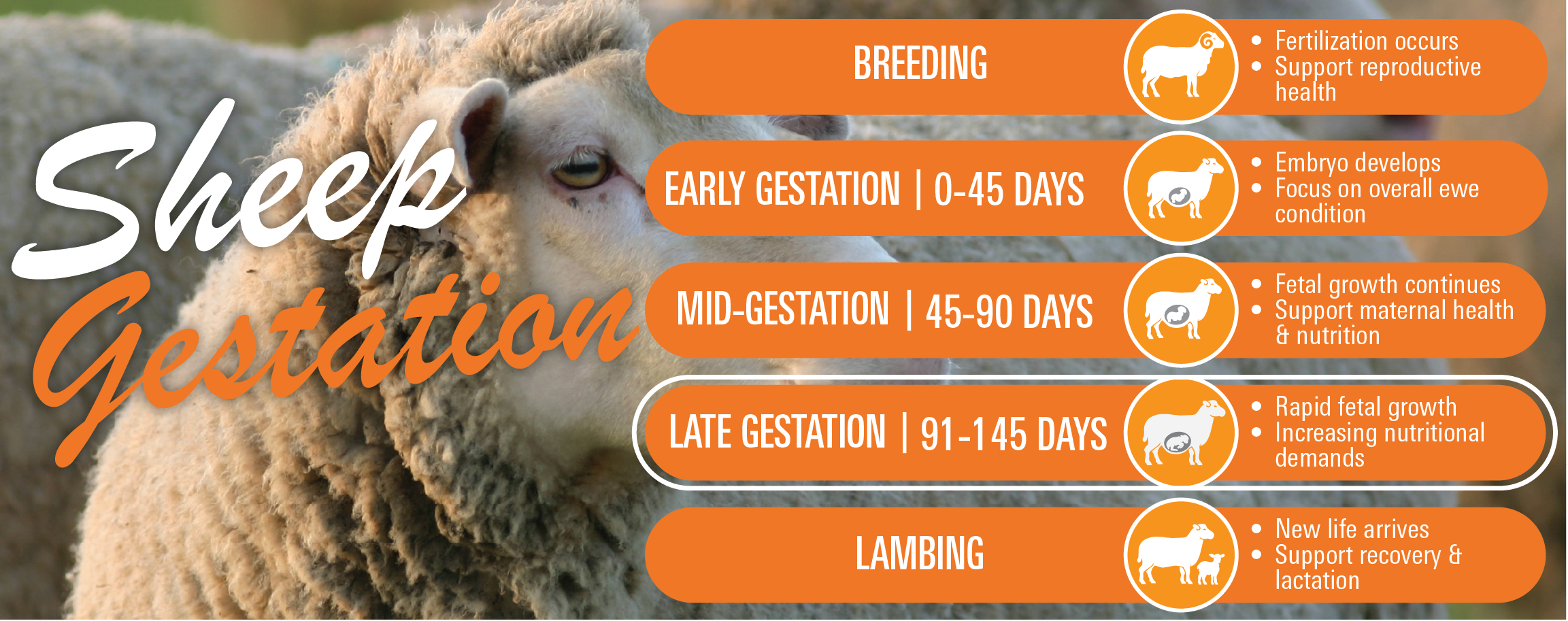
A ewe’s nutritional needs change as pregnancy progresses. Early gestation, mid-gestation and late gestation each bring different nutritional considerations, and the quality of the forage or feed available can also influence what needs to be supplemented.
A successful nutrition program considers the entire gestation period rather than waiting until the ewe is close to lambing.
Early and Mid-Gestation Nutrition
During early and mid-gestation, fetal growth is slower than it is during the final weeks of pregnancy. That does not mean nutrition can be overlooked.
Maintaining appropriate body condition is important, and ewes still need adequate energy, protein, vitamins and minerals to support their own health and the developing pregnancy.
This is a good time to evaluate forage quality and determine whether the base diet provides what the ewe needs. Mineral supplementation can help fill nutritional gaps and provide important nutrients consistently throughout gestation.
Maintaining a sound nutritional program early in pregnancy also helps set the stage for the increased demands that come later.
Late-Gestation Nutrition for Pregnant Ewes
Late gestation is when nutritional management becomes especially important. As fetal growth accelerates, the ewe needs more nutrients to support both herself and her developing lambs.
Energy and protein requirements increase, but vitamins and minerals should not be overlooked. Calcium, phosphorus and trace minerals all play roles in supporting normal development and preparing the ewe for lambing and the beginning of lactation.
Feed intake can also become more challenging late in pregnancy. As the uterus takes up more space, a heavily pregnant ewe may have less room for feed even though her nutrient requirements increase.
That makes the quality and nutrient density of the diet especially important during the final weeks of gestation.
Nutritional Needs of Ewes Carrying Multiples
Not every pregnancy has the same nutritional demands. A ewe carrying twins or triplets has greater nutritional needs than one carrying a single lamb.
Multiple fetuses mean more fetal growth to support, and that can increase the ewe’s requirements for energy, protein, vitamins and minerals during late gestation. Producers should consider pregnancy status when developing their late-gestation nutrition program. If ewes can be grouped according to the number of lambs they are carrying, nutrition can be more closely matched to their needs.
The goal is to support the ewe without overfeeding and to provide the developing lambs with the nutrients they need for healthy growth.
Nutrition is Vital to Gestation, Fetal Development
Since we know how important mineral supplementation is to gestation and therefore fetal development, don’t you want to ensure your ewes get the best nutrition possible? DuraFerm® is a line of nutritional supplements for sheep and goats that supports optimal digestion and nutrition for maximized performance at every stage of production.
“Make sure all ewes, recips and donors, are on Concept•Aid® mineral to make sure they get their trace minerals,” said Sam Silvers, BioZyme Senior Manager of Small Ruminant Technical Sales Support. “It’s also important to ensure the ewes are not overly fat or not too thin.”
With different formulas, there is a DuraFerm mineral ideal for any sheep flock’s operational goals.
DuraFerm® Concept•Aid® Sheep
Are you looking for a loose mineral that is ideal for your flock’s year-round nutrition needs? DuraFerm Concept•Aid Sheep is a free-choice vitamin and mineral supplement for sheep designed to support reproductive success.
It contains AO-Biotics® Amaferm®, a prebiotic research-proven to enhance digestibility and high levels of vitamin E for reproductive tract repair. Additionally, it supports embryo production and conception using organic trace minerals.
DuraFerm® Concept•Aid® Sheep Protein Tub
Another quality product that might even be more ideal for late gestation into lambing is the DuraFerm Concept•Aid Sheep Protein Tub. This protein tub with vitamins and minerals for sheep is designed to support reproductive success. This protein tub with vitamins and minerals for sheep is designed to support reproductive success.
The 125-pound tub contains the Concept•Aid sheep mineral package in a 16% natural protein tub. It supports embryo production and conception using organic trace minerals and high levels of vitamin E.
Like all DuraFerm products, it contains Amaferm to enhance digestibility.
Frequently Asked Questions About Sheep Mineral Nutrition and Fetal Development
What minerals do pregnant ewes need?
Pregnant ewes need a balanced supply of both macro- and trace minerals. Calcium, phosphorus, salt and magnesium are important macrominerals, while trace minerals such as zinc, selenium and manganese support a variety of biological functions.
The exact mineral requirements depend on factors including the ewe’s stage of gestation, diet, forage quality and number of lambs.
Do pregnant ewes need more minerals in the third trimester?
The third trimester is a time of increased nutritional demand because fetal growth accelerates. The ewe’s overall nutrient requirements increase during late gestation, making it especially important to evaluate the complete diet and provide a balanced mineral program.
How does mineral intake affect fetal development in sheep?
Minerals are involved in many processes related to fetal growth and development, including bone formation, muscle development, immune function and metabolism. Providing adequate minerals as part of a balanced diet helps support normal fetal development.
Minerals are only one part of the equation, however. Energy, protein, vitamins, water and overall diet quality also matter.
Can sheep get too much copper?
Yes. Sheep are particularly sensitive to copper toxicity. The amount of copper a sheep can safely consume is influenced by the overall diet and interactions with other minerals.
Because of that sensitivity, sheep should receive a mineral specifically formulated for sheep rather than a mineral intended for cattle or other species. Producers should also avoid adding supplemental copper without knowing the copper concentration of the existing diet and mineral program. DuraFerm makes species-specific vitamin and mineral supplements for sheep with no added copper.
What should I feed pregnant ewes in the third trimester?
A late-gestation feeding program should provide adequate energy, protein, vitamins and minerals based on the ewe’s body condition, forage quality and number of lambs she is carrying.
The third trimester is not the time to overlook mineral nutrition. A balanced sheep mineral can help provide nutrients that may be lacking in the base diet while supporting the ewe through late pregnancy and into lambing and lactation.
Why is mineral important for lamb development before birth?
Minerals support several biological processes involved in fetal growth, including skeletal development, muscle development, immune function and metabolism. Providing adequate mineral nutrition to the ewe helps support the developing lamb before birth and contributes to the ewe's overall nutritional status throughout pregnancy.
Get your DuraFerm Today
Ready to support your flock's nutrition throughout gestation and give your next lamb crop a strong start? Get your DuraFerm Sheep products powered by AO-Biotics Amaferm today. DuraFerm is available through the extensive BioZyme dealer network. Locate a dealer near you today. You can also buy our products online.
You can also learn more about DuraFerm from our educational blog series or by signing up for our newsletter.